
To view this video please enable JavaScript, and consider upgrading to a web
browser that
supports HTML5
video
Where can you find the original Star Wars droid C-3PO, a 25ft-long shark called Bruce and the most famous pair of shoes in cinema history? And all this, alongside what’s likely one of the strictest rules in Hollywood?
That would be the Academy Museum, opened in Los Angeles across seven floors in 2021 – and yes, that’s the same Academy of Motion Picture Arts and Sciences which has awarded the Oscars each year since 1929 to the movies its members have judged best.
Founded as a space for AMPAS to finally house and display film props, costumes and memorabilia of all sizes (including Don Corleone’s original desk from The Godfather), it extended the organisation’s collection beyond only the 2D objects and film prints thatithad been able to store at the Margaret Herrick Library.
But now, as both the Academy – founded in January 1927 – and the Oscars approach their respective centenaries, that collection extends to more than an astounding 52million objects.
Obviously, not everything can be displayed at once, with the Academy rotating new exhibitions in routinely.
One showing for Metro’s visit is an exhibition to mark the 50th anniversary of Jaws, alongside celebrations of Studio Ghibli’s Ponyo and icon Marilyn Monroe, with The Horror Show – a special exhibition honouring the genre’s enduring popularity – opening just ahead of Halloween.


Jaws was the world’s first blockbuster, popularising the wide theatrical release model and claiming the highest grossing opening weekend at the time, as well as the biggest box office haul until Star Wars two years later.
Much from the making of the film has turned into fable in the intervening years – director Steven Spielberg could never have predicted the cultural impact his shark movie would have – so the Academy was ‘looking to confirm stories that fans talk about,’ assistant curator Emily Rauber Rodriguez tells Metro.
There’s everything here from the exact Panavision camera used underwater to a buoy yanked out of the water by a local once filming wrapped – and even a beer can.
But the pièce de resistance is surely Bruce, Jaws’ sole surviving full-scale shark model, cast from the original mould in the ’70s to appease visitors to Universal Studios before it was later dumped at a junkyard, rescued and restored, and now hangs permanently above visitors to the Academy Museum.


While the Academy continues to grow its collection of three-dimensional objects, by way of auctions and donations, its displays also rely on loans from Academy members.
‘A lot of them kindly will donate their objects to us. Often, they’re like, “Come down to my basement, I have a bunch of stuff in my garage,” And we see what they have. We cultivate a lot of relationships with eyes towards the future.’
Planning exhibitions far in advance, Rodriguez says that approaches to help support the upcoming horror one to people working in the industry were made ‘several years ago’.
Of course, Sinners made history ahead of this year’s Oscars with its record-breaking 16 nominations, so it’s likely such a prestigious film will make an appearance then.
However, it will only just be permissible, as the Academy Museum cannot display anything from a film that’s potentially within Oscar contention. And that’s a rule it must rigidly stick to, no matter how keen studios may be to skirt it.


‘Everything has to be a year out, prior to that we don’t want to show favouritism to any film that could be nominated,’ says Rodriguez. ‘Especially in our early days, we had a few studios be like, “Hey, can we do a pop-up of this movie that just came out?” and we’re like, “No, let us know next year!” That’s one of the things we have to think about, as an academy entity.’
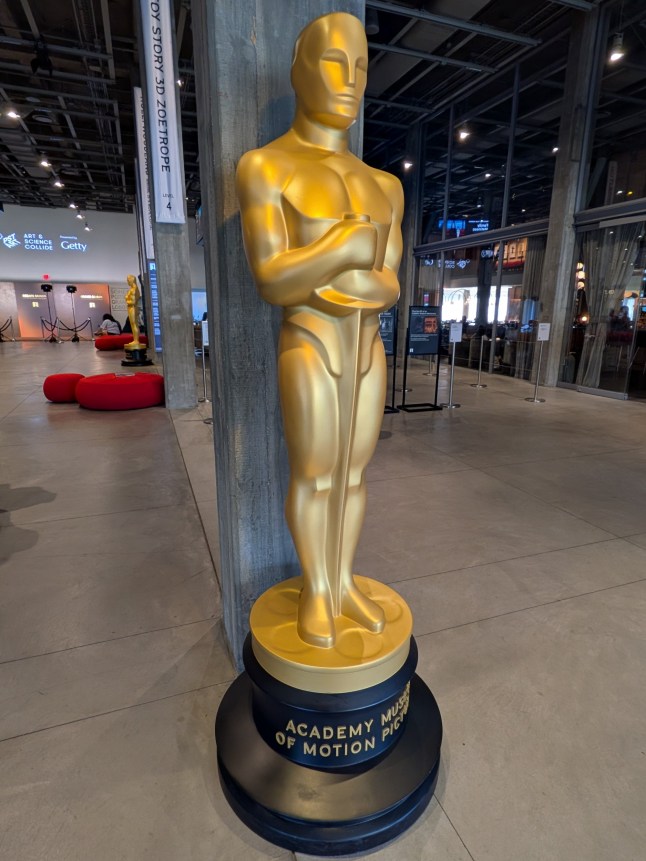
You may wonder if the Academy Museum strictly considers only films that were nominated for or won Oscars. After all, there’s a whole room dedicated to the famous statuettes, as well as several scattered across its floors. It doesn’t, although ‘more iconic Oscar wins’ can shape an exhibition. The curators are separate.
‘We look at it maybe as two separate voices: the Oscars can award their awards based on their own criteria, based on the reflection of that year and what people were thinking, what movies people loved in that time. But here we can be a bit more [open].’


Rodriguez points to a John Waters exhibition the Academy Museum held a few years ago when ‘obviously his films aren’t supposed to be Oscar winners, or he didn’t make them to win Oscars’, instead ‘reflecting against’ that bar as a more transgressive filmmaker.
The museum staff are able to take a bit more time to reflect on the legacies of films that grew into cult classics.
A film that’s been beloved as a classic for decades though, is 1939 Judy Garland musical The Wizard of Oz, with another jewel in the crown of the Academy’s collection being a pair of Dorothy’s ruby slippers. These, Rodriguez explains, are the key item visitor after visitor will ask after if there’s ever a time they are not on display – so the museum works hard to make sure that happens as rarely as possible.
It’s a challenge though, when film objects, especially then, were only designed to last for the span of the shoot, or even just that one shot.
Rodriguez explains: ‘We have a delicate balance of how long do we want to put things out for? A lot of them are very colour sensitive or light sensitive. With something like this, whenever we take this away, people are like, “Where are the shoes? I came here to see the ruby slippers!”


‘We have a few objects that people always want to see, and we’re aware of that. So we try to [balance] as healthy as we can keep them, but also letting people see them.’
The Academy’s pair are exquisite – not as worn as some others, adding to the theory they were used for close-ups – and also a correct pair, rather than one of two mismatched pairs out there, Rodriguez adds, with two left-foot and right-foot shoes.
It’s clear to staff that the slippers and Bruce the ‘mascot objects’.
And, obviously, while Bruce is suspended high above any sneaky damp-palmed tourist, not every object or costume is behind glass for protection. Most loans tend to be – and Dorothy’s highly sought-after shoes certainly are – but otherwise the museum keeps everything just beyond arm’s length, measuring touch distance to avoid anyone stepping or leaning on exhibits, or being tempted to reach out by proximity.
If you are keen to get your hands on a real Academy Award though – the Academy Museum is the only place where you can hold a genuine Oscar statuette that’s ‘unsigned’, rather than belonging to someone, in the world.
It’s also an Oscar that’s been made to be awarded, with the maximum number manufactured each year ahead of results on the night revealing exactly how many individual gongs will be given out.